Spider Star
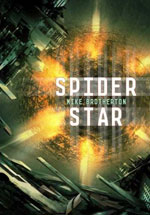
The human colony on the planet Argo has long explored and exploited the technology left behind by an extinct alien race. But then an archaeology team accidentally activates a terrible weapon...
Read More.Praise for Star Dragon
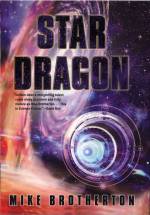
"Seldom does a storytelling talent come along as potent and fully mature as Mike Brotherton. His complex characters take you on a voyage that is both fiercely credible and astonishingly imaginative. This is Science Fiction."
-- David Brin"Star Dragon is terrific fare, offering readers a fusion of hard science and grand adventure."
-- Locus Magazine"Star Dragon is steeped in cosmology, the physics of interstellar travel, exobiology, artificial intelligence, bioscience. Brotherton, author of many scientific articles in refereed journals, has written a dramatic, provocative, utterly convincing hard science sf novel that includes an ironic twist that fans will love."
-- Booklist starred review"Readers hungry for the thought-provoking extrapolation and rigorous technical detail of old-fashioned hard SF are sure to enjoy astronomer Brotherton's first novel."
-- Publishers Weekly"Mike Brotherton, himself a trained astrophysicist, combines the technical acuity and ingenuity of Robert Forward with the ironic, postmodern stance and style of M. John Harrison. In this, his debut novel, those twin talents unite to produce a work that is involving on any number of levels. It's just about all you could ask for in a hardcore SF adventure."
-- Paul di Fillippo, SCI-FI.COM
Search
The Difference Between Hard Science Fiction and Mundane Science Fiction
January 25th, 2008
Jim Kelly’s essay in Asimov’s this month is about “mundane science fiction.” Mundane science fiction is, according to wiki:
Mundane Science Fiction is a sub-genre of science fiction. Inspired by an idea of Julian Todd, the Mundane SF movement was founded in 2004 by novelist Geoff Ryman among others.[1] It focuses on stories set on or near the Earth, with a believable use of technology and science as it exists at the time the story is written.
The central ideas are:
- That interstellar travel remains unlikely; that Warp drives, worm holes, and other forms of faster-than-light travel are wish fulfillment fantasies rather than serious speculation about a possible future.
- That unfounded speculation about interstellar travel can lead to an illusion of a universe abundant with worlds as hospitable to life as this Earth. This is also viewed as unlikely.
- That this dream of abundance can encourage a wasteful attitude to the abundance that is here on Earth.
- That there is no evidence whatsoever of intelligences elsewhere in the universe. That absence of evidence is not evidence of absence — however, it is considered unlikely that alien intelligences will overcome the physical constraints on interstellar travel any better than we can.
- That interstellar trade (and colonization, war, federations, etc.) is therefore highly unlikely.
- That communication with alien intelligences over such vast distances will be vexed by: the enormous time lag in exchange of messages and the likelihood of enormous and probably currently unimaginable differences between us and aliens.
- That there is no present evidence whatsoever that quantum uncertainty has any effect at the macro level and that therefore it is highly unlikely that there are whole alternative universes to be visited.
- That therefore our most likely future is on this planet and within this solar system, and that it is highly unlikely that intelligent life survives elsewhere in this solar system. Any contact with aliens is likely to be tenuous, and unprofitable.
- That the most likely future is one in which we only have ourselves and this planet.
Geoff Ryman has contrasted mundane science fiction with regular science fiction through the desire of teenagers to leave their parents’ homes.[2] Ryman sees too much of regular science fiction being based on an “adolescent desire to run away from our world.” However, Ryman notes that humans are not truly considered grown-up until they “create a new home of their own,” which is what mundane science fiction aims to do.[2]
By 2007 the mundane science fiction movement was noteworthy enough that Interzone decided to devote an issue to the genre.[3]
In his Asimov’s essay, Jim Kelly wondered, “how was MundaneSF all that different from what had up until then been called hard science fiction?”
Well, as a self-proclaimed “hard sf” writer I have an opinion. Let me start off by saying I don’t write mundane science fiction in general because I find it, on its own merits, boring and uninteresting. At least to me. One example is Kim Stanley Robinson’s book Red Mars, which isn’t a bad book, but didn’t surprise me enough in particularly good ways or provide enough sense of wonder to read the others in the series. I’d seen the technology one place or another, and the speculation was so probable that I was bored through stretches.
Mundane science fiction also offends me by the notion that we know what is most probable. We don’t, in my opinion, and some (but by no means all) of the conventions it rejects are not at all improbable. I agree that FTL should be off the table and don’t use it in my own novels. But that doesn’t mean that interstellar travel won’t happen, and it does seem that planets are abundant. We’ll have the technology in decades or less to even identify Earth-like worlds with life (e.g., through detecting O2 absorption signatures). SETI has barely scratched the surface of parameter space and we sure haven’t been looking very long. And so what if vast distances “vex” interstellar communication? I don’t get that. That would still be cool as hell and assuming we don’t go extinct what are centuries? And this business about abundance of resources…all the quantitative evidence historically has indicated that Malthusian disasters are very overrated. The abundance we have in the 20th and 21st centuries would boggle the mind of the richest people on the planet in previous times.
In short, I find it narrow, uninspiring, and unlikely from some perspectives.
What I write, and define to be “hard sf” is science fiction that doesn’t stray into the impossible. I have aliens in my stories. I have interstellar travel. I have tenuous connections over vast distances. I have a future of abundance. It’s a mix of preference and what I see as probable. And on the science issues I strive for as much accuracy as I can muster. I have pages and pages of calculations to justify some events and physical structures in my novels. Some of it is simple, some is complex, and some my readers will never notice.
So to summarize, mundane science fiction is science fiction that improbably anticipates no new discoveries or technologies and makes some narrow-minded assumptions that are unwarranted, while hard science fiction merely limits itself to avoiding scientific error and impossibility.
I know which one I prefer.
They both suffer from unfortunate, sucky names, don’t they?

You can follow any responses to this entry through the RSS 2.0 feed. You can leave a response, or trackback from your own site.
William Barton once wrote a very bleak novel, Dark Sky Legion, that featured a kind of galactic civilization that worked despite not using FTL. There’s one probably improbable technology in the book, matter teleportation used for matter duplication, but that could be explained away via very high advanced matter restructuring technology. So, to say that you can’t write a book about interstellar travel when you’re limited to STL just shows your lack of imagination.
And Greg Egan also wrote about a galactic civilization limited by STL in Schild’s Ladder and his next book features one too. Slightly more optimistic than William Barton’s book.
Thanks for the comments, Jorn. Greg Egan is one of the few writers out there who can make my work look soft. He’s written some fantastic books with some amazing science and ideas. I don’t know William Barton’s work as well, but will keep an eye out.
[…] agree. I’ve recently blogged about mundane science fiction, which I don’t exactly write. I think that’s the part of the field these days that is […]
[…] of the story from that perspective. I am a hard sf writer, but not a mundane sf writer (see this post for more), which means that I don’t write anything I know to be scientifically wrong, but I […]
[…] aspects of the story from that perspective. I am a hard sf writer, but not a mundane sf writer (see this post for more), which means that I don’t write anything I know to be scientifically wrong, but I […]
Adware Alert – No Spyware…
I suggest you to take a free scan and remove dangerous spyware and adware from your computer. Even if you think your computer is clean, you should scan and you will be surprised….
[…] seems to fall into the camp advocating mundane science fiction rather than hard sf (see my explanation of the distinction), but we have common goals: educating people about the realities of the endeavor to explore space […]
Interesting.
I just find out that Mundane Science Fiction is really what I am interested into.
When Jules Verne wrote his stories he was writing mundane -boring?- science fiction. Fantasies without losing contact from reality.
We should realize that time travels, green martians, interestellar FTL travel, thinking robots and many other objects of SF are just fantasy, that have nothing to do with science.
Yes, we could find vampires and phantoms some day, but I wouln’t count on it.
Although I don’t like nay sayers that say that realistic interstellar travel is unlikely or will not happen, I refuse to ignore the laws of physics. I like Hard Science Fiction the best such as James Cameron’s Avatar. FTL is a real disservice and nucense to the field of interstellar travel since it is an epitome of handwavium. I envision aliens and interstellar travel, especially since I am designing an interstellar spacecraft dubbed Project Orion II.
I am offended by thse who say that intrstellar tragvel period is just fantasy, it shows a lack of imagination. I know that interstellar travel is real, just that FTL drive is fantasy. There is a DIFFERNECE between interstellar travel and moving faster than light. In my favorite movie; a hard sci-fi film,the ISV Venture Star travels no faster than 70% the speed of light and is based on the laws of physics. I am for interstellar travel as long as handwavium such as FTL is not involved. Mundane sci-fi sucks because it it way too pessimistic, narrow-minded, etc. Don’t tell me that sublight interstellar travelis losing contact with reality.
I feel vulnurabe on science ficton due to two opposign forces, the first one being mundane sci-fi which is overly pessimistic and narrow-minded adn the other si handwavium sci-fi with all of its FTL-wishful thinking, stealth in space, etc. That’s right, both of them bother me. I prefer Hard Science Fiction because it is open minded and at the same time follows the laws of physics. I am designing a realistic interstellar spacecraft dubbed “Project Orion II” and it will run on deuterium-helium3 fusion pulse propulsion and a secondary realistic deep space propulsion as well. Orion II will NOT go faster than light and instead go at like 10-15% the speed of light. FTL is a disservice to the field of interstellar propulsion because it ruins starflight’s credibility. I like how in Avatar the ISV Venture Star onloy accelerated to 70% the speed of light instead of going FTL. Just because FTL is fantasy does not mean that interstellar travel is fantasy.
[…] seems to fall into the camp advocating mundane science fiction rather than hard sf (see my explanation of the distinction), but we have common goals: educating people about the realities of the endeavor to explore space […]
This highly affordable and easy to manage solution is far superior
to the unfortunate alternative of relying on creating your own resources, in order to accomplish these tasks.
This means court cases will be piling up in these countries as clients sue to get their money out.
Surprisingly, the Japanese media reported little on reaction towards karate’s rejection.
This can be possible either you need them stored temporarily or
for a long-term period. Add to that an increased distance,
culture and language between destination and present location and it can look like a lot of your hair is going to end up in your hands.
[…] is a type of science fiction known as “mundane science fiction” that is generally limited to speculation that is within known science and does not require […]