Spider Star
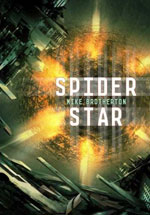
The human colony on the planet Argo has long explored and exploited the technology left behind by an extinct alien race. But then an archaeology team accidentally activates a terrible weapon...
Read More.Praise for Star Dragon
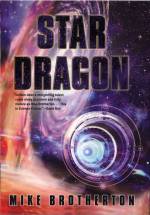
"Seldom does a storytelling talent come along as potent and fully mature as Mike Brotherton. His complex characters take you on a voyage that is both fiercely credible and astonishingly imaginative. This is Science Fiction."
-- David Brin"Star Dragon is terrific fare, offering readers a fusion of hard science and grand adventure."
-- Locus Magazine"Star Dragon is steeped in cosmology, the physics of interstellar travel, exobiology, artificial intelligence, bioscience. Brotherton, author of many scientific articles in refereed journals, has written a dramatic, provocative, utterly convincing hard science sf novel that includes an ironic twist that fans will love."
-- Booklist starred review"Readers hungry for the thought-provoking extrapolation and rigorous technical detail of old-fashioned hard SF are sure to enjoy astronomer Brotherton's first novel."
-- Publishers Weekly"Mike Brotherton, himself a trained astrophysicist, combines the technical acuity and ingenuity of Robert Forward with the ironic, postmodern stance and style of M. John Harrison. In this, his debut novel, those twin talents unite to produce a work that is involving on any number of levels. It's just about all you could ask for in a hardcore SF adventure."
-- Paul di Fillippo, SCI-FI.COM
Search
Ten Issues for Hard Science Fiction
September 8th, 2008
There are a number of issues that continue to keep coming up in hard science fiction, or any science fiction trying to get the facts right. I just helped my collaborator here a few days ago answer a reporter’s questions on one of these (humans expelled into space without space suits). These things should always be right. There’s no excuse in this day and age. We’ll start with the space expulsion.
1. Human exposure to vacuum. People don’t blow up. And probably most aliens don’t, either. A number of movies/TV shows get this right: 2001, Battlestar Galactica, Event Horizon. Some don’t (e.g. Outland). Get it right.
2. FTL. Faster than light travel. It’s a trope of the field. It should be recognized that this is typically necessary for interstellar and even interplanetary travel if characters are doing it in Vipers or X-wings without bathrooms, or for any short timespan. That’s a start. But it should be acknowledged and some excuse given, at a minimum. In the most rigorous cases, writers should realize that FTL implies time travel or at least non-causal effects and has philosophical implications about free will.
3. Teleportation. It’s not just for Nightcrawler. It may or may not violate light-speed and causality depending on the implementation, but it should be recognized that it needs to be handled carefully. If conservation laws are violated, it could be used to create perpetual motion machines and infinite energy. If not, things get more interesting. How are energy differences made up? Think about it. Get it right, or give some lip service to the problems.
4. The Fermi Paradox. Why aren’t aliens common in the universe and already in abundant evidence here on Earth? There are at least 50 possible reasons. Have one if you’re dealing with aliens in the galaxy and space travel, or if you’ve got humans exploring the galaxy and there are no aliens. It doesn’t have to be a big part of the story, but have a reason.
5. The Singularity. On the short timescale, technology is slower than we expect (a few years or a decade or two). On somewhat longer timescales, it goes fast. Humans think linearly, not exponentially. How far ahead can you really imagine? OK, take that timeframe, and add a few thousand years. Or a million. Where are we then? Can’t imagine it? Neither can anyone else. Don’t worry about it too much. Write your story, but be aware of the issue.
6. The dangers and difficulties of the space environment. Radiation. Lack of gravity. Sex. Getting sick.
7. Alien communication. This isn’t necessarily easy. Acting like it is may move the story along, but it isn’t realistic. Maria Doria Russel wrote a great book in The Sparrow over misunderstanding aliens, as have others, but many have not. Don’t pull a Star Trek on this. You don’t have to create a great story about language exchange like Barry Longyear did with “Enemy Mine,” but again, lip service at a minimum. Dot your “i”s and cross your “t”s.
8. Alien chemistry/biology. Can we eat aliens? Can they eat us? Is DNA the only system for living things? Are our amino acids common to life, or are we just a subset of the possibilities. I’m not saying I know the answers for sure for these questions, although I have ideas, but you better know the answers for your universe and they should be plausible.
9. AI. Artificial intelligence. Strong or weak, we’ll have some version in the future. Which? What can it do? What can’t it do? Note that this is related to the singularity issue, and other things like post-human existence. Is it possible to download humans? Or make simulations that are for all practical purposes alive and independent? I don’t know the answers, but you have to make some decisions if you’re writing sf, because some version of this technology will be with us.
10. Nanotech. Variations on it are coming, or are here already. We’re gaining the ability to manipulate matter on the atomic level to build novel materials and structures. What’s possible? What isn’t? Nanotech isn’t magic, and like teleportation, keep in mind conservation laws regarding mass and energy. Also, as a guide, keep in mind biological systems that are nature’s nanotech. In principle, nanotech can operate very quickly and you can use bacteria as a guide for what’s possible.

You can follow any responses to this entry through the RSS 2.0 feed. You can leave a response, or trackback from your own site.
Great list.
[…] Brotherton takes a look at “Ten Issues for Hard Science Fiction,” but its basically a list of Star Trek buzz words. The real issue: Can we escape the […]
Excellent summary Mike, I’m particularly sensitive to the singularity. Any story set in the future can look absurd without comprehending this.
For example, what’s the difference between telepathy and having a cellphone embedded in your head? The answer is not much. So unless characters in the future have “telepathy” the writer is pretty much ignoring a reasonable projection of future technology. Vernor Vinge really nailed the new telepathy in Rainbows End.
I just finished Alastair Reynolds new book “House of Suns” in which he tries to get around the causality paradox (in this case FTL via wormholes). I am curious at what you think about his solution, if you have had time to read this “Hard SF”, expansive novel.
I am wondering if it is consistent with the current state of physics and cosmology.
Bill
I have read some Alastair Reynolds, and enjoy him, but not HOUSE OF SUNS. He has a PhD in astronomy like I do, so is likely aware of all the issues and the current state of the art. I doubt there’s a clean way to really get around this, however, except in a philosophical “there is no time” sense.
I would think that a good writer need be very aware of current trends in technology and physics. For instance some of Einstein’s theories are being, if not challenged, then modified. Take for instance several experiments that have proven faster than light actualities. Then there’s quantum mechanics phenomena where two atoms at distance can ‘communicate’ reactions. Or that other fun thing where atoms have spontaneously ‘appeared’ from nowhere (another dimension ?). Hopefully the LHC will show us even more interesting tricks in physics.
Any of those concepts can be interwoven in a story and built upon, I’d think. Imagination is just a fancy way of saying…”we’ll get there someday”.
Re: No.9
The continuing evolution of artificial intelligence (or the supposed singularity) will throw up huge philosophical problems. Does an AI with the exact memory and intelligence of a human be afforded the same human rights? Would it even consider itself to be equally sentient? And if so should we consider it to be such?
Alastair Reynolds deals with this issue superbly in The Prefect.
These questions essentially negate a lot of SF written to date; they point towards a post-human future which we can only understand as allegory. Or a universe in which we are rats in the walls.
Here’s how I deal with them.
1. Vacuum. I have no problem with people not exploding. (remember Earthlight by Clarke?)
2. FTL. I actually prefer the ‘no empires’ sublight space travel; the galaxy is only a single human lifespan edge to edge at a single continuous G of accelleration I recall reading in Analog 20 years ago. Sure, that’s thousands of years for the stay at homes. So what? Space travel is a one way trip into the future.
3. Teleportation. If we posit extra dimensions to siphon energy into and out of we can balance any equation. True, we get free zero point energy. So that has to be part of that story. Teleportation means ‘post scarcitiy.’
4. Fermi. There are many possible answers; some violate the principal of mediocrity (the notion that one should assume that where you are isn’t a special magical place) some violate what we know about the drake equation and the age of the universe. (Our light cone should be filled with dyson spheres; it isn’t.) The actual observed universe we exist in is stranger than science fiction; we are either the first, the only, or…berserkers. I prefer the notion of some sort of leaky quarantine, a la star trek.
5. The singularity. Unless we posit AI the singularity just means really fast technological progress. It’s manageable as an idea. Once you have superhuman self-modifying intelligences, you’re staring into the sun and writing allegory again.
6 AI, immortality, uploading downloading and all that jazz. I suspect that us meat people will occupy a niche similar to the blue green algae that created the oxygen that allowed all subsequent life to be so zippy and wonderful. The algae, for their eras of toil, were relegated to stinky bogs here and there. The only way to write stories where humans are at all interesting or in charge is to have us enslaving our betters via some sort of super-potent asimovian brainwashing. This seems unlikely as well as icky.
Moravec came to the idea in Mind Children that perhaps the AIs would like space, and we would dick around at the bottom of gravity wells. Why not? There are no monocultures in nature. Again, the real question is what is our niche?
Immortality and transcendence: uploading and modifying your own intelligence, becoming the AI, is an interesting notion; again, we are left to describe the super-intelligent experience with our own, normal intelligence.
Nanotech: AI, nanotech, and the singularity with uploading and downloading essentially melt reality into any form you want. The problem is, again, why would that form create stories we could tell? Why would its visuals, its tactiles, its shape and substance be resolvable into narrative?
I think most SF now hovers at the edge of the singularity, dipping into it, orbiting it; touching it and dancing away, in such a way as to keep characters human and sympathetic.
The singularity is so much closer than space travel that again, it seems that humans don’t go to the stars; our mind children do.
Some people can write SF in this environment. I have a very hard time doing so, other than the near future, edge of the singularity stuff. Which means space travel is closed off to me, which is a shame.
Jay
Jaques Vallee became interested in UFOs when he found technicians at radar installations spontaneously destroying tapes of tracked objects which didn’t correspond to known aircraft flights. They weren’t told to. They did it instinctively.
This is why UFOs are so interesting; they are objects of ridicule and humiliation. As Darwin was pilloried as an ape man, UFO researchers are called ‘enthusiasts’ and ‘buffs’ and are taunted with the term ‘little green men.’ Some of these guys have a lifetime of aviation experience; they can do some science; they work with the sighting data trying to figure out what the hell is going on, and if it’s venus, they say it’s venus.
The real reason UFOs are ignored is that they are a cosmic insult. They don’t want to interact with us in ways that would categorically prove their existence. It would be effortless for them to leave behind irrefutable traces. They behave in many ways like unfalsifiable phenomena. If they are ET, then ET is treating us like animals.
One of the notions is that we are being systematically culturally desensitized to the idea of aliens to prevent societal collapse when The Horrible Truth emerges. (They don’t want us to become a Cargo Cult.)
Wrong post on the UFOs, Jay? Want to copy it over to the new post?
“FTL implies time travel”? No it doesn’t. It only implies that Einstien has the math wrong. I know that the closer we get to light speed the slower time travels. But it doesn’t follow that exceeding light speed makes time go backwards. Or any such thing.
It does, actually. Check out:
http://www.gdnordley.com/_files/Graphic.pdf
For starters…
Regarding FTL, I think there are ways around it. Wormholes, for example, even though keeping a workhole open and stable enough for transportation would require breakthroughs in our understanding of physics. But wormholes are allowed by physics as we know it. So if you allow just a little bit of physics beyond what we know today, there is a way around.
The singularity is one thing that causes me problems when trying to write about the future beyond 50 years from now or so. If we create AI’s which are on our level or even superior, then it’s possible that they will be able to improve on their own design. Not only will they have access to computer power which grows exponentially, they can also improve their own implementation of AI. Which means we humans will very quickly be left hopelessly behind, unless we manage to develop upload technology and join the intelligence race. Whichever the case may be, our great-great-grand-children will be very, very different.
Actually, with the Alcubierre (warp) drive, one could achieve FTL travel without relativistic effects. With this kind of propulsion, the ship isn’t actually moving faster than light.
http://en.wikipedia.org/wiki/Alcubierre_drive
That’s a good point, Brant, but like wormholes, there are causality issues and any FTL is potentially time travel. Time travel is rarely well dealt with in science fiction either. Pick your poison and do it right, I say.
Hi Mike,
I stumbled over your site searching for sci fi books that I don’t know – and look what came up 🙂
I read your list of challenges for hard scifi, and I agree with you, that scifi writers should be able to explain these things within the borders of their fiction. You could almost call it a contract between reader and writer.
Personally I am a master of arts, not science, so I won’t claim to have any solutions to your challenges myself (probably why I write fantasy and not scifi), but as I said I never the less agree with you about scifi writers having an obligation to their readers when it comes to this.
Apart from writing fantasy, I also run a newly started website about my favorite sf books (http://www.bestscifibooklist.com) so of course I went straight to Play.com and bought Star Dragon in the hopes of liking it enough to put on the list 🙂
Looking forward to reading it!
Best regards
Sven
Thanks, Sven.
Did you actually PAY for Star Dragon? I released the book for free under a creative commons license, and no one is allowed to be making money off the ebook. Sigh. One more thing that sf writers have to deal with, copyright infringement, apparently.
Hi Mike,
I am pretty old fashioned (that or I just haven’t been able to afford an ebook-reader yet, since everything is too expensive i Denmark), so I bought a used paperback edition. It was only like 8 euros or so, so I will manage 🙂
But I wasn’t aware, that the ebook was free – I like that!
The Paperback is published by something called Saint Martin’s Press Inc.
Still looking forward to reading it!
/Sven
OK, Sven, that’s cool! Hope you enjoy it.
I just wanted to add “The Color of Distance” to the list of books that deal wll with the issue of alien communication. I last read it some time ago, so I don’t recall if it addresses LANGUAGE very much, but the higher level issues of communication – cultural misunderstandings, assumptions, social status, cooperation – are beautifully detailed in ways that most science fiction stories neglect entirely.
Mike,
at least on this end, the link to the FTL article is a file 404.
I like it when folks get the science right, although I’m particularly fond of writers’ efforts when they can’t or don’t want to deal and find creative (and convincing) ways to avoid the subject.
Like “How the heck am I supposed to know how the drive works, I’m not a physicist!”. Reasonable, as very few are, or (Harrison – explaining the bloater drive) use humorous means that play with the laws and theories.
[…] off my (rapidly spreading) butt and actually punch some numbers into a calculator. His article ten issues for hard science fiction is a well-timed reminder that there is a reason we stick the word ‘science’ in front of […]
ufo sightings…
[…]Ten Issues for Hard Science Fiction[…]…
# 2 is just plain goofy. The last thing I want to see in a scifi novel/show/game etc is some long winded techno babble about faster than light travel. It’s a necessary literary device. Deal with it. Most SciFi is just fantasy with a crunchy robot wrapper anyway.
We already have a star trek and it’s boring the hell out of everyone. Don’t replicate it’s nonsense dialogue.