The human colony on the planet Argo has long explored and exploited the technology left behind by an extinct alien race. But then an archaeology team accidentally activates a terrible weapon... Read More.
Praise for Star Dragon
"Seldom does a storytelling talent come along as potent and fully mature as Mike Brotherton. His complex characters take you on a voyage that is both fiercely credible and astonishingly imaginative. This is Science Fiction."
-- David Brin
"Star Dragon is terrific fare, offering readers a fusion of hard science and grand adventure."
-- Locus Magazine
"Star Dragon is steeped in cosmology, the physics of interstellar travel, exobiology, artificial intelligence, bioscience. Brotherton, author of many scientific articles in refereed journals, has written a dramatic, provocative, utterly convincing hard science sf novel that includes an ironic twist that fans will love."
-- Booklist starred review
"Readers hungry for the thought-provoking extrapolation and rigorous technical detail of old-fashioned hard SF are sure to enjoy astronomer Brotherton's first novel."
-- Publishers Weekly
"Mike Brotherton, himself a trained astrophysicist, combines the technical acuity and ingenuity of Robert Forward with the ironic, postmodern stance and style of M. John Harrison. In this, his debut novel, those twin talents unite to produce a work that is involving on any number of levels. It's just about all you could ask for in a hardcore SF adventure."
-- Paul di Fillippo, SCI-FI.COM
Can You Figure Out What this Science Fiction Novel is Trying to Say?
July 17th, 2012
This is passed on from a friend of a friend, who is a Spanish teacher using a science fiction novel (I don’t know which one) in her class, and had this question:
I’m working on a sci fi novel to use in class and there is a reference to (translated): the reflection point of the Earth.This is the paragraph from a hypothetical future:
“Region L.H. 527 of the Andromedan galaxy. A recently mapped zone. The reflection point of the Earth that appears in the diagram isn’t to be found in this representation (one sent in from outer space).”
Is this referring to the perspective of the star map? That is, the one received from outer space is not from a perspective from Earth?
Frankly I’m a little stumped. I don’t know if it is bad writing, difficult translation, or what. I’m sure I don’t know everything, but I’m tempted to write it off as technobabble. Thought I’d post about it and see if it made sense to anyone.
What Personnel Are Needed on a Spaceship Exploring Strange New Worlds?
July 11th, 2012
I like to write stories set in outer space on space ships, and I think a lot about stupid things like what is the necessary crew size and their expertise. There are some guides based on long duration seafaring, but those are somewhat imperfect in the space environment.
So far, we haven’t had space missions of the kind I’m thinking about — ones that take months to years that don’t have options for quick escape or rescue.
From a fictional standpoint, as well as a practical standpoint, minimizing crew size is important.
While it’s possible to assume improvements in our technology that would allow computers or robots to fill in for certain duties, it’s not clear when or how exactly those will occur. It’s also possible to assume aliens exist, but it’s not clear that they do or that we’ll encounter any of them any time soon.
So, imagine a spaceship on a mission to visit a nearby star system, like one of the missions proposed such as Project Icarus. What group of humans of minimal number is realistically needed?
I believe you need:
1. A commander. Someone capable and trustworthy in charge whose word is law. A small group of people light years from home is not a place to practice democracy in an emergency.
2. A doctor. People get sick and injured — people who cannot be replaced.
3. An engineer. Ships and their equipment get damaged — equipment that cannot be replaced unless you bring spares.
4. A scientist. Someone needs to know about stars, planets, the space environment, and, if the mission is exploration, data taking and analysis. Someone needs to locate objects of interest in the star system and prioritize them.
5. A pilot. Someone needs to know how to move the ship around and get to the objects of interest.
If you don’t have other information, like the presence of aliens, intelligent or otherwise, I think this is the minimum skill set. Of course it’s possible for one person to have multiple skills, but you want some redundancy. It’s possible that the ship and science goals are too complicated for 1-2 people each and a larger team is needed.
Have I forgotten something critical? Again, we’re assuming no known aliens. Aliens would require an additional complement to the crew concerning communication, defense, negotiation…perhaps even space lawyers, ugh!
Three Crimes of Cliche Modern Superhero Movies Commit
July 9th, 2012
I have enjoyed the last decade of plentiful, quality superhero movies very much, and the few winners from earlier than that. After watching The Avengers and The Amazing Spider-Man recently, both of which I enjoyed, I was reminded of some things I see too often in such movies that is starting to annoy me whenever I even suspect it’s going to happen. That’s bad, because it throws me out of the movie and is a sign of lack of originality. In fact, we’re talking cliche here, something to be avoided.
Now, there’s a lot of things I could complain about with regard to superhero movies. The laughable science, the ease at which hero and villain find each other when it’s time for a fight, or the how a high school boy can hand sew a costume that would take first place at any Halloween party (a real-life superpower!), for instance. But I want to give those a pass for now and focus on some crimes, if you will, that movies specifically commit that I’ve seen too many times already.
The first crime: ditching the mask early and often.
Superheroes generally guard their identity because anonymity protects them and their loved ones. It’s an extremely rare event for superheroes to remove their masks and flaunt their secret identity, and maybe a movie should represent an especially important and rare set of events in a hero’s life, but come on! Here’s a short list:
Batman — almost every version. Alfred and Robin get to know, but we have Vicki Vale in Tim Burton’s first movie, a climactic cowl removal in the sequel, to Rachel Dawes in Nolan’s version, and a handful of others.
Daredevil — again with the girlfriend, Elektra, but she knew in the comics, so pass there. But the Kingpin at the end, for drama, I assume, and irony needing to be underlined for inattentive viewers.
Spider-man 1 & 2 — every villain knows, and his girlfriend and his best friend who becomes an enemy.
The Amazing Spider-man — again with the girlfriend, her father, and the villain. Really?
The Avengers — Iron-Man is public, but Captain America loses his mask by the end, and Hawkeye never gets one.
The X-Men — they mostly skipped the costumes even. Some X-men usually go masked, some don’t, but let’s just have some cool black leather battle suits and skip the dorky outfits, huh? I liked First Class better in this respect.
I think this comes from the belief that actors need face time to do their jobs well and that general audiences don’t really want to see crazy people in stupid, dorky costumes. This is the same urge that gets the crew in Prometheus, or the Hollywood writer pulling their strings, to remove their helmets.
The Second Crime: Intertwined Hero/Villain Origins.
Whether or not the heroes’ origins are tied into that of their movie foes, or any foes at all, they are often forced into that mold. I’ll just mention a few rather than making a list. In the first Tim Burton Batman movie, the Joker and Batman “make each other.” In the Nolan version, Batman’s origin involves the villain Ra’s al Ghul. Neither were involved in the original Batman origin. Daredevil suddenly gets the Kingpin messing up his childhood. The new Spider-man helps create the Lizard…who was involved in creating Spider-man. Iron Man’s villains have stolen, or believe he stole, the same technology. The Red Skull is the Nazi super soldier to America’s Captain America.
The funny thing is that Lex Luthor, Superman’s nemesis, actually has a vendetta against the hero due to an accident leading to the loss of his hair, arguably caused by Superman. In the movies…no relationship there. Maybe revenge for hair loss is not Hollywood worthy. Okay, it is kind of stupid. Maybe for the next reboot, however, we can shave Fabio for the role and I’d believe the rage.
In any event, yeah, it makes a nice, tight storyline to have intertwined origins but I’ve now seen it a dozen times. I’d like to see the heroes move on with their lives and face some new, unrelated villains. The Joker in The Dark Knight…who knows his real origin or motivations? They probably have nothing to do with Batman, but he’s still a great character in a great story.
The Third Crime: Superpower Training Montages
Movies with these also often have a cliched end scene with the hero, now finished with the main story line, out doing their thing and having a great time. This probably results from, in part, the fact that so many superhero movies insist on being origin stories and the desire to show the audience the powers without belaboring them. Still…I’m pretty sick of it. I usually say to myself, “Okay, self, 45 seconds of training now…and probably one clever bit to smile at in there, too.”
It was pretty bad with the new Spider-Man movie since so much closely paralleled the recent Raimi movies. The only new thing was the shots from Peter’s point of view.
The X-Men, Batman, and the Avengers actually do spend a lot of time training in the comic books. A lot of them just do their thing, or the training is implied. I’m just tired of seeing the same movie solution of the 1980s montage and would like to see some other takes on it than I have been seeing regularly.
What about you? Any pet peeves with the recent superhero movies?
Walt Whitman Listened to, but did not Hear, the Learn’d Astronomer
June 28th, 2012
In my opinion, anyway. Here’s the poem, When I Heard the Learn’d Astronomer (and “heard” does rhyme with “Learn’d” better than “listened to”), from Leaves of Grass.
WHEN I heard the learn’d astronomer;
When the proofs, the figures, were ranged in columns before me;
When I was shown the charts and the diagrams, to add, divide, and measure them;
When I, sitting, heard the astronomer, where he lectured with much applause in the lecture-room,
How soon, unaccountable, I became tired and sick;
Till rising and gliding out, I wander’d off by myself,
In the mystical moist night-air, and from time to time,
Look’d up in perfect silence at the stars.
To be fair to Whitman, most people do listen and applaud. Just not him. He’s the rare bird, so that saves it for me, and I do recognize not everyone’s first inclination is quantitative.
But I have to say that for me, a “Learn’d Astronomer,” the direct experience of enjoying the stars in perfect silence is merely nice, and greatly enhanced by my quantitative understanding of what they actually are. I mean, come on, they’re faint points of light in the sky in some vague, ill-defined patterns. I enjoy looking at them, but I enjoy looking at a lot of things.
For me, the science enhances everything I look at. Let me provide some evidence that Whitman and the Whitman’s of the world today, can be turned on to science with how it has enhanced the experience of stars:
Star Size comparison:
Carl Sagan on humans as “star stuff”:
Living in the age of stars:
Life cycle of stars:
And don’t forget…without astronomers essentially nothing would be known about black holes, neutron stars, white dwarfs, cool M stars invisible to the naked eye, what stars are made of, how far away they are, how big they are, how energetic they are, how long they live…essentially nothing.
When I look up in perfect silence at the stars, my experience is, in my opinion, much more profound and meaningful due to the knowledge science has provided us about what they are. They are super amazing fantastic objects!
I think we need more scientist poets… (Ellie Arroway agrees, I’m sure.)
How a Bad Relationship with Encyclopedia Brown Screwed Up Prometheus
June 22nd, 2012
Encyclopedia Brown is a fictional boy detective in a series of stories by Donald J. Sobol, and one of my heroes, who uses facts and logic to solve mysteries. The stories about him always ended with him telling you the solution to the mystery, with a note to turn to the back of the book to see how Encyclopedia Brown figured it out. Kind of a 1970s kid version of CSI.
I was reading HULK FILM CRITIC’s comments on Prometheus and came across this interesting comment about the childhood of Damon Lindelof, Prometheus and Lost scriptwriter:
HULK, did you hear Lindelof’s interview on NPR (Fresh Air?) the other week? He explained that when he was a kid, he had tons of Encyclopedia Brown books – they were mysteries and on the last page they would give the answer – “Mr. Jenkins was the one who stole Billy’s bike.” etc – and Lindelof would ALWAYS flip to the end first and read the answer before reading the actual book. His Father caught him doing this once, and went and ripped out the last pages of all of them. So he said he grew up just making up his own ending to all of them. Speaks to a small part of the problem…
So, he was the kind of kid who wanted to immediately know the answer without exploring the mystery, then was denied the solution. This plays into HULK’s thesis that Lindelof has been obsessed with the idea of wanting knowledge and being denied that knowledge, and that this becomes what he does over and over again in his scripts with his characters, but more importantly, also what he creates as a writer and subjects the viewer to. Want to know what’s going on? Too bad, this writer isn’t going to tell you. Figure it out yourself the way my Dad made me.
This is horrifying.
To me, story is about making sense of some aspects of life, about educating others vicariously, about have experiences with meaning and without the boring and confusing parts that get in the way of that meaning. Otherwise it’s a giant and unsatisfying waste of time! You might as well watch the weather channel and try to figure out why Thor is pissed off at the Florida panhandle, or watch the stock market and tell yourself the Dow is tanking because…<spin mental wheel>…uncertainty about how the Supreme Court is going to rule.
The uninformed and inexpert speculations of a viewer are unlikely to figure out what’s really going on in real life, or in an Lindelof story. And based on what I saw in the science part of Prometheus, I can’t actually trust Lindelof to be an informed expert about how anything really works, so I can’t even begin to guess at what he’s aiming at. And he intentionally doesn’t supply the answers.
Lazy, unsatisfying writing.
Encyclopedia Brown was very clever, and you knew he knew what he was talking about. You had mystery after mystery solved via well-reasoned fact-based arguments in the back of those books. Young Damon could have gone to the library to find copies of the books, like I did, that didn’t have the solutions ripped out. I was the kind of kid who read the stories first and then tried to figure them out myself before checking the answer. It meant a lot to me if I had the right answer based on the facts presented in the story. That brought satisfaction and closure.
Lindelof never learned that. He somehow learned, or learned to be satisfied with, being presented a story and never knowing for sure the author’s intent. Or frustrated, and working out those frustrations by writing.
Look, I love a little mystery in stories, some things left unexplained, or in fact, things intentionally inexplicable. The alien pilot in the original Alien movie is (or was) a great example of that. My own novels leave mysteries. But they’re never mysteries about the basic plot or what the story is about!
Who would keep reading Encyclopedia Brown stories with the solutions ripped out? Who would watch CSI without explanations for how they know the bad guy is guilty?
Not me, and not many others, either, I believe.
Prometheus would have been better written by Donald J. Sobol, or any writer who understands what makes for a satisfying story and actually delivers it. HULK believes that Lindelof knows all this, too, but intentionally writes to frustrate based on deep-seated obsession. He could well be right. Maybe my hero Encyclopedia Brown screwed up Prometheus.
It’s too late now, but it was possible, so let me explain how.
Before I do that, let me note that some people loved Prometheus, like Roger Ebert, even though he takes issue with Creationist commenters who think the movie is pro Intelligent Design. There are some who are willing to ignore the bad science, plot holes, and inconsistent characterization in service to deep allegory. I don’t care if a story is an allegory or not — it has to make sense on its own surface level, and as quite a few othershave pointed out, it doesn’t. The more you think about it — and it’s clearly a movie made for people who like to think about movies — the less well it fares. Here are some problems I’ve been thinking about, and how to fix them.
I’m going to go more or less chronologically through the movie and point out various issues and discuss how they could have been fixed. I’ll try to play fair and give the movie makers the benefit of the doubt in some cases, but even in those cases, it hurts the viewing experience to sit there thinking, “That doesn’t make sense.” Mostly I’ll discuss science and logic issues, sometimes characterization issues, and not try to remake the story. It’s clear that film makers do get science advisers, including Prometheus, which probably helped, but they didn’t get enough help.
The first scene, like the first line in a book, is important. It sets the stage for what follows and is really there to tell you what the movie is all about. The first scene of Prometheus should have been cut. That’s the only way to improve it, in my opinion. Here the spoilers begin. The first scene shows an engineer purposely drinking black goo (borrowed from the X-Files, it seemed at times) to destroy himself and seed a planet with life. This planet may or may not be Earth, but it’s clearly a tip of the hat to the myth of Prometheus giving humans life. Except that we know from the fossil record that life has been around a long, long time. Billions of years. We also know evolution works. We also see the Engineers DNA being snipped apart. If this is the origin of life on Earth, that works. Except it’s ludicrous to believe in the Engineers keeping the same form and same technology over the course of billions of years. As we learn later, human DNA is a “perfect match” to that of the Engineers. That is ludicrous. Humans are not 12 feet tall and hairless. We’re also only a few percent different from other great apes.
Let this be the first lesson about writing science fiction. You don’t get to throw out existing science. New speculative elements still have to adhere to what we know about fossils, evolution, DNA, and timescales. I didn’t know enough of the story to immediately be bothered by the opening, but as events unfold and more information became available, the less reasonable I found it. It literally doesn’t make sense to me now. Just cut it and leave the origin to be a much more plausible tinkering with ape DNA, splicing in Engineer DNA, that I’ll infer given enough hints.
Our second opening scene is with our archeologists finding new cave paintings dating to 35,000 years ago, more or less. As in others spanning from a couple of thousand years ago to then, there is a depiction of giants pointing to a star pattern, “the invitation” of the movie. As find out very quickly, this star pattern is matched by only one direction in the sky, and is not an obvious set of stars to pick out by eye. We also find out that the key planet we’re being directed to is some 35 light-years from Earth. Here’s something too many viewers like myself know: over the course of thousands of years stars this close move realtive to each other and to the Earth. The constellations 35,000 years ago were different than a few thousand years ago. What they could have done, which would have been cool, was to have an evolution in the star patterns indicating the proper motions of those stars relative to us, and us requiring a lot of computations to extrapolate back in time to reconstruct the star pattern which no longer exists today. Already I hear someone complaining that this is a complicated idea and too difficult to convey to a movie audience. I disagree. I think it would have been cool and made our scientist couple out to be super clever.
Then let me comment on that 35 light-years figure. On screen it was shown as 3.something x 10^14 kilometers. That’s stupid. That’s someone wanting to use scientific notation to indicate the place is a gazillion miles away (not “half a billion miles from Earth” as Charlize Theron’s character says at one point, which I give a pass since the character probably doesn’t know herself). There’s another instance of unnecessary scientific notation, so this was a clear decision to set the story as scientific, as science fiction, not a fantasy horror story with the trappings of science fiction. With the third opening, the ship, we enter hard science territory.
Obviously the Prometheus has faster-than-light (FTL) capabilities, even though we only hear about ion engines. It does 35 light-years in two years, and there’s no mention of relativity. Furthermore, there are indications that the same amount of time will pass on Earth, so definitely no relativity. This would take a lot to fix, actually, without resorting to wormholes. It seems FTL is part of the Alien franchise universe, and I’d accept it as a viewer. Not hard science fiction, but an accepted trope of the genre.
We have awkwardness on board the ship. Apparently a lot of the crew are not only ignorant of the point of the mission, finding the ancient astronauts/creators, they haven’t even met each other before. That seems unbelievable, and smacks of lazy writing, not wanting to start too slowly but also wanting to make introductions easier. Revise it! Tossed me out of the story thinking it was ridiculous the different people had boarded and got into their sleep chambers on a 4+ year journey without actually having lots of meetings and orientations. Just bad writing.
Now, I’m actually ok with the idea of ancient astronauts and alien creators as the basis for a science fiction story. It just has to fit within known science, which includes evolution and the vast evidence for it. The briefing on the ship makes it sound like it’s an either/or. It isn’t. It has to be an “and.” Newtonian gravity didn’t stop working when Einstein developed relativity. Evolution doesn’t stop working just because someone seeded a planet with their DNA pieces…actually that’s when it starts.
Next issue is finding the alien base. They just go down to the moon and fly around until someone says, “Turn here! Nature doesn’t make straight lines!” Or something like that. Why not send out some orbiting satellites and let your smart computers find the alien base? Could be done in a single scene, adding an extra minute. Maybe. And it would remove a bit of stupid luck.
Want to talk stupid? The couple of guys who opt out of alien invasion get lost. One of them is the guy responsible for the lidar probes mapping the place. The fucking mapper gets lost?! Really?! I need to punch the person who made that decision. Give them a reasonable excuse to get side-tracked. Something interesting to investigate. Anything other than “We got fucking lost because we’re the fucking idiots you hired for the most important mission in the history of mankind!”
Now, the group that finds itself in the alien room with the murals and pots of black goo…and worms that have survived millenia…they touch stuff. Real archeologists don’t touch anything. And why is the black goo there? And activated when they go in? I understand the allegorical explanation, but when you have bioweapons you don’t do it like this. Or your species goes extinct, which the Engineers should have done billenia ago if they’re this dumb. To be fair, so are the humans…
What follows are artificial plot problems, too common in Hollywood movies and a product of weak writing, stuff like when the woman is running from the killer and falls down. We have the super storm, which they could have waited out. They didn’t, and we have the dropped head. And then, we apparently have no safety protocols on the ship because we bring the head on board and pump it full of electricity.
Oh man, was that dumb.
As soon as we have an infected human wanting to come on board, we kill him with fire. The head goes in the lab and explodes, the crew member gets killed with few repercussions. Shaw never confronts Vickers about killing her lover — because we get distracted by immaculate alien conception. But I’m jumping ahead of myself…back to the exploding head.
And WTF fuck does the head explode? This was where I was starting to think we have a dumb, dumb movie. Imagine taking a mummy head, or any part of a mummy, and adding electricity. What does it do? NOTHING! Except maybe smolder. And why hadn’t it been eaten by the worms or whatever kind of living critters are in that room already? What have they been eating for 2000 years?
David the enigmatic android steals a sample of the black goo and gives it to our male scientist, who will do “anything” to meet the Engineers. We have a repetition of duplicitous androids here, from HAL to every other android in every other aliens movie, more or less. David did not follow orders on the spot. Bad David. But WTF would he give the black goo to a human? If I were kind, I’d say he learned something from the hieroglyphics, but that information should have been shared somehow. Too many question marks.
And when he’s killed, instead of quarantined off ship, or in a room designed for that…which everyone should fucking know about!!!…we conveniently have the impregnation. If you’re going to impregnate a sterile woman, let us know more than 5 minutes before you do it that she’s sterile, otherwise it rings false. Really bad timing.
I honestly thought that pregnancy thing was a dream sequence, because otherwise it was too stupid.
Not stupid in principle, just as shot. Alien reproduction as pregnancy is a staple I can take. The way it was done was dumb in Prometheus.
When she extracts her alien kid, we’re told the autodoc is for men only. WTF? Now, there’s an obvious fix to this: the autodoc is for the old guy, not his daughter. But I really don’t see with the tech available why anyone would build such a machine for one sex only. It’s ridiculous. It’s a software issue, not a hardware issue. It’s another artificial problem that this society would not have. It’s just adding a little gratuitous tension in a scene that doesn’t need it.
And, as we see later, the alien baby grows really fast. It’s not a problem inside the womb — there’s food there to grow on. It’s a problem inside the ship. All we need to see, during the tour of the facilities, is that the room with autodoc also has extensive food stores. I assumed that the baby monster in the original Alien grew so fast in part because it found food somewhere. If Ridley Scott doesn’t understand the conservation of mass, he’s not allowed to bite me. He just need to avoid science fiction in the future.
OK, lots more happens, some of which doesn’t make sense. Aliens waking up after thousands of years, intelligent ones, might want to scope out their situation before pulling a “Hulk smash,” allegorical explanation or no. If they’re really that uptight, I say we go after them and remove them from the game of life, because they’re too inflexible to take seriously. And while the other alien movies established that bodiless androids need an electric jumpstart, not so David. I’ll accept this because he’s a special case.
But when the Engineer ship goes down, after the Captain and pilots of Prometheus are a little too accepting of someone’s word and display a weird easiness about accepting their own deaths, the alien ship crashes. We learn that there are other ships. And the Engineer COULD HAVE RAN FOR ONE. He’s already capable of long runs in the poison atmosphere with his 100% human DNA. But no…he has to go after our heroine to kill her. Why? I don’t have the slightest clue except he’s an alien and it’s scary. And he gets his just desserts running into her giant face-hugging baby.
I think that’s enough stuff to fix. Some of my fixes are obvious and easy, but some of them require extensive rewrites since they drop the tension level in some cases.
Some final thoughts and issues.
David the android is not supposed to be able to feel, but it’s strongly suggested that he does. He acts like he does, “liking” Lawrence of Arabia, and saying it’s natural to “hate your parents.” I’m tired of the error of the android being simultaneously human and not human (Mr. Data!). Just be consistent.
At least one of the script writers has a background writing for Lost, which was about the mystery, not the answer. While I’m fine with aliens acting alien and everything not being explained (except perhaps by a forced metaphor/allegory), too many inexplicable things makes for a dissatisfying viewing experience.
I’m sure there are other problems I’ve missed, or failed to discuss. Already afraid I’m in the “too long, didn’t read” category. Other suggested fixes?
We’re already living in a science fiction future, but we’ve still got too many things that suck.
I spent three hours waiting for tires today. I spent four hours on this task a few weeks ago. I don’t mind waiting as long as I have something constructive to do — some work, reading, or writing. But twice? They apologized for not having the tires last time, ordered them, and didn’t realize they were still missing one. Got new brake pads installed for free, but not a lot of fun.
I’ve also had some minor medical bills sitting around for over a month. The insurance company website (Cigna) isn’t very clear on what to do. Everything is different from the last time I had to submit these myself. I’m tempted just to pay them, but I’ve already paid a lot more into the monthly insurance and most of the bills should be covered.
And a friend of mine just let me know that he’s getting divorced.
In real life you have to pay taxes. Simple or complicated, you got to do them and pay them. Legal issues? Insurance issues? Usually not simple and easy. Maintenance on the house or car? Haircut? Teeth cleaning? Vet checkup?
It’s so nice to crack open a book or watch a movie where people are light-years away and their problems seem both more important and more interesting than the bullshit real life gives us on a daily basis. With fiction, you can touch on real life issues with a single paragraph:
“He told his computer to do his taxes, investing a few minutes of his own to check the deductions. How tedious!”
“With universal health care covered by his taxes, there was no medical bill or insurance to fight with.”
“While he was at work, the car drove itself to the garage for new tires. He had more important things to worry about.”
As do I. Got a few serious posts for later this week, and a full slate of research. I also have to go back Friday to get tires…
My personal feeling is that religion is incompatible with science, but there have certainly been religious scientists capable of doing good science. People compartmentalize and turn off their critical brains when it comes to certain topics. I don’t see the difference between being critical about astrology and being critical about any supernatural claims. Still, a lot of religious people and religious sympathizers/accomodationists can get behind good science and our scientific perspective on how things work in our universe.
Not so Young Earth Creationists (YECs) who practice “Creation Science” or other religiously motivated nonsense. There is no compartmentalization and no respect for science. Don’t believe me? Let’s look closer.
Now, I don’t want to spend the $11.67 to buy the book, or even the $0.16 for a used copy (plus hefty shipping and handling), but the study guide is available online for free. Here are some choice quotes, with commentary:
“Satan has attempted to get people to believe in astrology and cosmic evolution, both corruptions of genuine astronomy.”
The term “cosmic evolution” is conventional astronomy that involves the Big Bang, by the way. We’ll get to more quotes clarifying that soon. It is also referred to as the “atheistic perversion” of genuine astronomy.
A discussion question: “4. What are some Bible verses that emphasize that God guides our lives?” Remember, this is The ASTRONOMY Book.
From Chapter 3’s summary:
“God created the universe during the creation week several thousand years ago. The creation week had six days of work and one day of rest. The universe did not begin in a big bang. There was no big bang. The big bang is a myth.”
From Chapter 3’s discussion questions:
1. Why is “cosmic evolution” a false idea?
2. Explain why cosmic evolution is not the same as true biblical creation.
3. Discuss some Bible verses that clearly state that God created the heavens.
7. Why do we know there was not a big bang?
8. What are some Bible verses that state that the creation is finished, and not evolving?
10. Why do evolutionists want to believe the universe is expanding? Is there conclusive evidence that the universe is expanding at all?
Chapter 5 refers to the constellation “the bear.” There are two constellations, Ursa Major and Ursa Minor…we talking big or little here?
Chapter 7:
“The moon is very unlike the earth and did not evolve from it. Neither did the sun evolve with the rest of the solar system outof a “nebula.” Both the sun and the moon are “young.” None of the planets, not even Mars, is fit for life. Only the earth was created to be inhabited (Isaiah 45:18). None of the planets except earth has ever had its own life.”
Absolute statements like these are not science. They’re anti-scientific. If we find life on Mars, or Europa, or someone else, these people will deny it, probably forever. They’ll see it as evidence of a conspiracy to contradict their religion, another atheist perversion by scientists like me. I should add that this chapter makes a big deal out of the sun being powered by gravitational contraction, a process that can let the sun shine for tens of thousands of years, but not the billions required by false cosmic evolution. Ignore the fusion-spawned neutrinos, please. Here’s some discussion questions in support of this:
8. Describe the idea of gravitational collapse for explaining where the sun gets its heat.
9. Why do evolutionists prefer the idea that the sun gets its heat exclusively from nuclear fusion?
10. Compare the evidence that gravitational collapse is happening in the sun, versus the idea that nuclear fusion is responsible for the sun’s heat.
11. What is some scientific evidence that the sun is “young,” not billions of years old?
12. What is the nebular hypothesis? Why is it a false idea?
13. What is some evidence that Mercury and Venus did not evolve, but were created?
14. How is Mars similar to the earth? How is it different?
15. Explain why Mars cannot support life. From the Bible, why would we expect that Mars has never supported life?
16. Why do evolutionists keep searching for evidence that Mars once supported its own life?
17. Why have evolutionists given up on the idea that Jupiter or Saturn could support life?
18. Explain some evidence that Saturn’s moon Titan was created recently, and is not billions of years old.
21. What do the many unique features of all the planets reveal about the character of God?
22. Why do you think evolutionists are uncomfortable with the idea that planets are all unique and different?
This stuff just floors me. This is not science. This is indoctrination, not just science wrapped in a religious worldview, with a smear against conventional scientists (AKA evolutionists) who have reached different, and better supported conclusions, compared to the YECs.
Let me quote the entire chapter 8 summary concerning stars and galaxies:
All stars are unique and different. Stars differ in size, color, temperature and other properties. Black holes are defined in such a way that they can never be observed. Science deals with objects and phenomena that we can observe. Therefore, black holes have never been seen and, strictly speaking, are outside the realm of science. The most distant galaxies are thought to be quasars some 14 billion light-years away. When astronomers view distant objects, they are seeing the object as it was in the past. This is called “look-back time.” There is evidence that light may have traveled more rapidly in the past (at speeds higher than 186,000 miles per second), making it possible for astronomers to see these distant objects in the few thousand years since the creation week. Thus the look-back time for quasars is no more than a few thousand years.
Ugh, where to start. As a scientist who studies black holes, well, ugh. This is the kind of intellectually dishonest compartmentalization I find frustrating. YECs and others want to say that science can’t apply to everything, that there are other ways of knowing. Not reliable ways, in my opinion. We also haven’t seen electrons, neutrinos, or the interior of the Earth, but science has let us learn a lot about them. I guess blind people can’t be scientists. And then the speed of light business…double ugh! YECs start with their “facts” and then try to fit observations to those facts, which is ass backwards. Again, not teaching kids science. Indoctrination. Some choice discussion questions from the chapter:
6. Why do evolutionists believe that black holes must exist?
9. What is look-back time? Explain why look-back time extends only thousands of years into the past, not billions.
10. God did not create exploding stars and other catastrophes. What is a possible reason astronomers can see exploding stars billions of light-years away, yet the universe is not billions of years old?
Chapter 9 sucks as bad:
Stars and galaxies show signs of ancient catastrophes. These catastrophes are a product of sin in the physical creation causing decay and destruction everywhere (Romans 8:20-22). Even the sun today is fairly chaotic and self-destructing. However, God has preserved the sun so that it is more stable than most stars, and capable of giving light and heat to life on earth. Most stars are very unstable. Some stars have exploded, forming supernova remnants. All stars are dying. The evolutionary idea of star birth has never been observed.
My friends who study star formation would be shocked, and the fact is that most stars are in fact very stable for long periods of time.
This stuff just speaks for itself:
CHAPTER 10 — CATASTROPHES IN THE SOLAR SYSTEM
Chapter Summary
The solar system shows many signs of catastrophes which happened to planets and moons in the past. As with the cosmos at large, sin is ultimately responsible for these catastrophes. Planetary moons seem to have exploded to form planetary rings. Jupiter, Saturn, Uranus and Neptune all have rings. A planet may have exploded to form the asteroids. This planet would have been between Mars and Jupiter where the main asteroid belt is today. Comets seem to be asteroids which orbit close to the sun, and many meteors seem to be asteroids which have been knocked out of the asteroid belt. Asteroids, comets and meteors have landed on the earth, causing in the past much destruction and loss of life. Perhaps this explains the ancient fear of unpredictable heavenly events. There is no evidence that a massive asteroid or meteor impact killed all the dinosaurs. The flood of Noah killed many of the dinosaurs. Mars once experienced a flood, which scientists acknowledge, while continuing to deny the reality of Noah’s flood on earth.
This is all funny and easy to ridicule, but if you look at the amazon link again, you’ll see that those people who bought this book bought the entire damn series of Creation Science books, probably for their homeschooled kids. It’s not the kids fault, but they’re likely to grow up into people less capable of critical thought who believe crazy things deserving of ridicule. People who try to get evolution removed from public schools and/or their religion inserted as science. These are not people who should be accomodated, or lied to. Their beliefs are falsifiable, and have been falsified. All beliefs are not made equal.
You can’t reason with them, and therefore you can’t be reasonable. Is there a better approach than ridicule for their own words, their own torture of science to fit their unsupported beliefs?
Now, there’s a lot of people who get confused about the difference between respecting the rights of people to believe what they want, and respecting other people’s beliefs. There is an important difference between the two. People believe a lot of crazy shit, and some of that shit they believe is dangerous. We should not respect it. We should respect the right to ridicule in those cases, although I’m open to more constructive approaches. I haven’t found any.
People teach this as “science” to their kids and it ought to upset you.
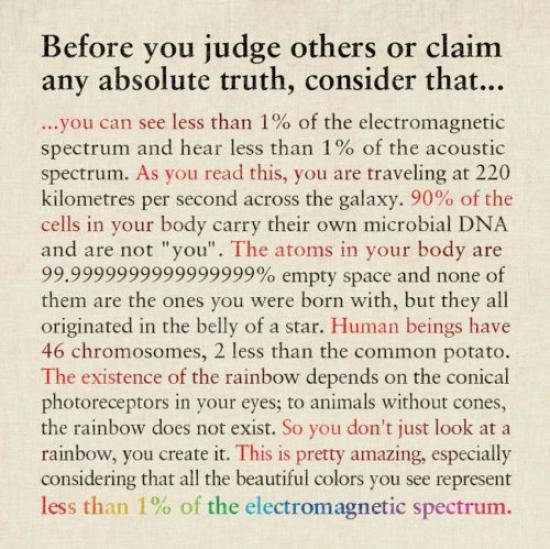
I’ve seen this on facebook recently, and another friend just emailed it to me, so let me post it here to launch a couple of points for discussion:
So how about if I knew all that already? And could even make some minor corrections? Do I get to be certain?
A quick google fails to bring up the origin of the graphic or quote. Anyone know? Might make its meaning clearer, as cool as it is on its own.
To me, this seems to be a message to be uncertain in a complex world that is much more than it seems. I’m ok with that message, although it’s a little hard to know who exactly it’s directed at. I suspect it’s directed at the scientifically illiterate who are nevertheless positive they have all the facts about our world. But thinking more deeply, I wonder…
There’s a part of me that sees possible irony here, too, however. Science makes a point of building more and more reliable theories, but rarely comes out with “absolute certainty.” The things to consider here, however, are all essentially scientific “facts.” Are they right? Absolutely certain?
What if we’re all part of a computer simulation, or the dream of a dragon?
I’d also be interested in replacing the headline with, “Science shows us wonders you can’t even perceive, and that your perceptions are wonders in themselves.”
Finally, this is a nice reminder for us thinking about and writing about non-human intelligences (science fiction writers, SETI scientists, etc.) that our senses and our knowledge create our experience of the world, and it can differ drastically from being to being. What color are radio waves? What does infrasound sound like? What is real and what is perceived? Is it possible to communicate in any meaningful manner with beings that don’t share our senses?
Looks like I picked the wrong week to quit taking acid…
My perfect SF novel, the kind I love to read, and that I’ll probably always be struggling to write, contains:
-One or more heroes who use, primarily, their intelligence to reach toward their goals.
-Spaceships in space.
-Aliens, usually to serve as a mirror for ourselves.
-Big stakes, at least life and death, and some action so it isn’t simply cerebral.
-Something original I haven’t seen before.
-Engaging writing that doesn’t draw attention to itself in service of a fast-moving plot.
-Few or minimal mistakes. I primarily see science mistakes, but obvious errors of fact destroy my suspension of disbelief.
I blame at least some of this on growing up with Star Trek, Star Wars, Battlestar Galactica, and the like. I have a need for the new and the alien, and the phrase “space, the final frontier” is embedded deep in my hindbrain. Computers and robots, steampunk and alternative histories, apocalypses, time travel…they’re just okay. Nothing wrong with them, but for a novel to be perfect for me, everything’s better with a spaceship.
I’ve seen a bunch of these lists on the heels of the success of the Avengers movie. Forbes has their top twenty (which dips into some bad ones in my opinion). io9 has their top ten comic book movies, which is unfortunately not restricted to superheroes (comparisons are apples and oranges too often). IGN has a list. So does a lot other places. They all need updating and rethinking, in my opinion.
I used to be a fan of the old Superman movies (the first and second anyway), but they’re full of inexplicable dumb stuff, and spawned super stupid sequels. I mean, the time travel thing at the end of the first, without consequences, was a cop out. The bizarre special powers at the end of Superman 2 like the giant plastic “S” chest emblem. WTF?
Something similar with the Tim Burton Batman movies, for me, although more of a case of now seeing a Burton movie than a Batman movie, and failure to stand up to the Nolan version.
And the fact is the special effects are better today. The financial successes have led to more money and talent making superhero movies than ever before. So I give you:
1. Perhaps a little flavor of the month, but let’s put Avengers at the top and start there.
2. The Dark Knight.
3. Watchmen.
4. Spider-man 2.
5. X-Men 2.
6. X-Men: First Class.
7. Spider-man.
8. Iron Man.
9. Kick-Ass.
10. Hellboy.
I hope I will have to revise my list after the summer is over and we have new Batman and Spiderman movies.
I’ve written in the past about peer review (and links therein), particularly my annoyances with how some referees don’t seem to be constructive about it, and in fact can be condescending assholes. I made my suggestions about improving it while keeping it anonymous. Another option is to remove anonymity, which I think does have drawbacks, but that’s the suggestion in light of “primate behavior” ala Matt Ridley’s review of David Maestripieri’s “Games Primates Play.”
Dr. Maestripieri’s most intriguing chapter is entitled “Cooperate in the Spotlight, Compete in the Dark.” He describes how people, like monkeys, can be angels of generosity when all eyes are on them, but devils of spite in private. Famously, the citizens of New York City turned to crime when the lights went out in the blackout of July 13, 1977-not because they were evil but because the cost-benefit calculus was altered by the darkness.
Dr. Maestripieri then offers a fascinating analysis of the conundrum of peer review in science. Peer review is asymmetric: The author’s name is known, but the reviewers remain anonymous. This is to prevent reciprocal cooperation (or “pal review”): I’ll be nice about your paper if you’re nice about mine.
In this it partly works, though academics often drop private hints to each other to show that they have done review favors. But peer review is plagued by the opposite problem-spiteful criticism to prevent competitors from getting funded or published. Like criminals in a blackout, anonymous reviewers, in the book’s words, “loot the intellectual property of the authors whose work they review” (by delaying publication while pinching the ideas for their own projects) and “damage or destroy the reviewed authors’ property” (by denying their competitors grants and publications).
Studies show that peer reviewers are motivated by tribal as well as individual rivalry. Says Dr. Maestripieri: “I am a Monkey-Man, and when I submit a grant application for peer review, I am terrified that it might fall into the hands of the Rat-People. They want to exterminate all of us…(because our animals are cooler than theirs).”
His answer (and it applies to far more fields than science) is total transparency with the help of the Internet. The more light you shine, the less crime primates commit. Once everybody can see who’s reviewing whose papers and grant applications, then not only will spite decline, but so will nepotism and reciprocity. Anonymity alters the cost-benefit balance in favor of competition; transparency alters it in favor of cooperation.
I’m a little concerned, however, that junior referees will hesistate to point out problems on papers authored by more senior scientists. I mean, I’m in favor of cooperation and constructive reviews, but we might get reviewers trying to suck up to more senior people, or junior referees declining to review papers at all. That’s not healthy either. I think I like my suggestions better, although I’m torn if the question is simply whether anonymity is better than transparency. In any event, I’d like referees evaulated and those evaluations used by editors whether the reviewers are anonymous or not.